

New data shows increase in youth gambling in Washington; prevention leaders call for stronger safeguards
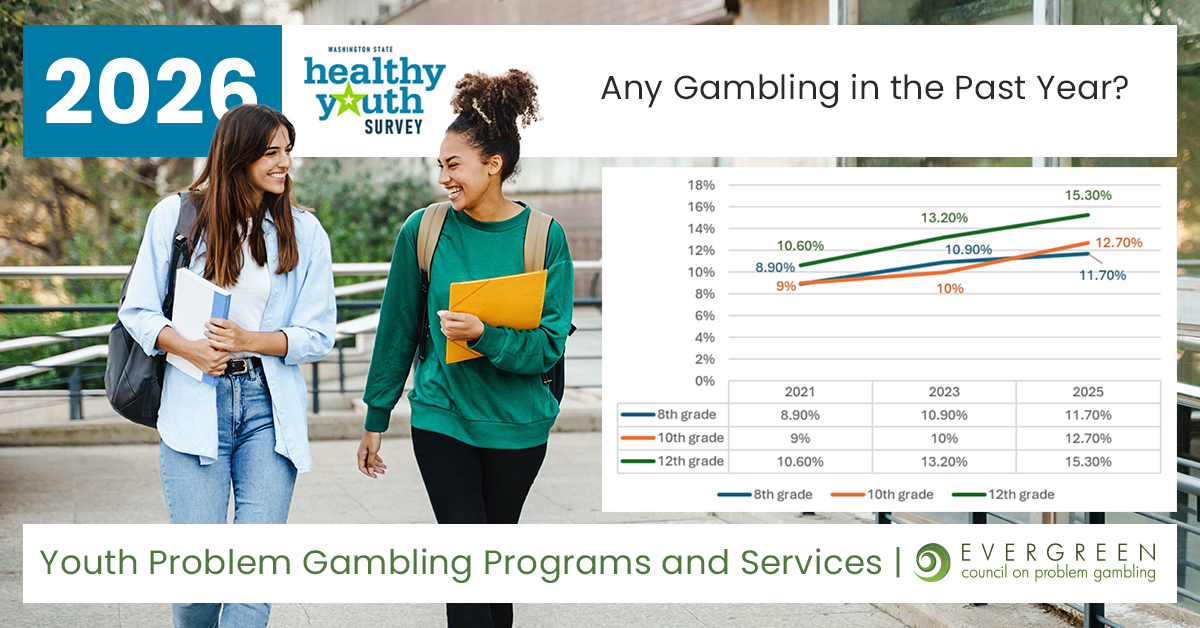
8th, 10th and 12th grade students show rise in gambling participation between 2021, 2023, and 2025 (Note: Numbers are estimates.)
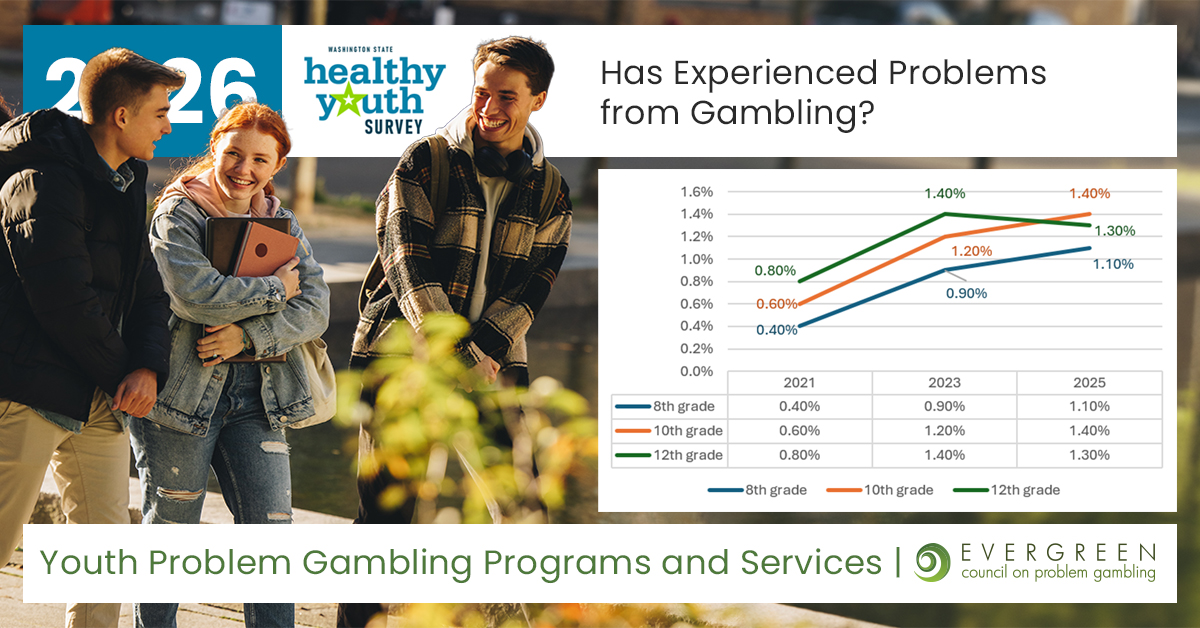
10th and 12th grade students show rise in problems from gambling between 2021, 2023, and 2025 (Note: Numbers are estimates.)
Evergreen Council on Problem Gambling Information Sheets for Youth, Young Adults, and Adult Allies.
The Healthy Youth Survey, conducted every two years in collaboration with the Washington State Health Care Authority, Department of Health, Office of Superintendent of Public Instruction, and Liquor and Cannabis Board, provides insight into the health and behaviors of students across the state. [askhys.net]
While many indicators of youth well-being, including mental health and substance use, have remained stable or improved in recent years, findings related to gambling suggest a different trend. [doh.wa.gov]
In 2025,
- 15.3% of 12th graders,
- 12.7% of 10th graders, and
- 11.7% of 8th graders
reported participating in gambling in the past year, representing an increase from 2021 and 2023 levels amongst grades 12 and 10. Gambling participation in grade 8 went down slightly.
“People should be alarmed by the increase in gambling among youth in Washington,” said Jeremy Whitaker, Problem Gambling Prevention Coordinator at the Washington Health Care Authority. “We’ve seen increases among all age groups surveyed over the past four years, but few communities are taking action to address this emerging threat.”
Expanding Access and Evolving Risks
Experts point to the rapidly changing landscape of gambling access as a key driver of these increases. Today’s youth are exposed not only to traditional forms of gambling, but also to new and often less regulated environments, including sports betting platforms, video games that blur the line between gaming and gambling, cryptocurrency, prediction markets, and blind boxes.
Paulina Zyskowski, Prevention and Community Engagement Specialist at the Evergreen Council on Problem Gambling, sees this firsthand. “Regulation cannot keep up with gambling innovation. We are seeing more and more gambling-like mechanics being introduced into the market without the guardrails that regulated gambling has. Young people particularly are targeted. It would be impossible to fully shield a teen from gambling marketing and advertising nowadays.”
A Need for Coordinated Prevention Efforts
The Healthy Youth Survey has long served as a critical tool for understanding youth risk and protective factors and informing prevention strategies across Washington. Prevention providers emphasize that addressing youth gambling requires a similar coordinated response. [askhys.net]
Key priorities identified by prevention leaders include:
• Strengthening safeguards that limit youth access to gambling platforms and features
• Increasing education and awareness for youth, families, and educators about emerging forms of gambling
• Integrating gambling prevention into broader behavioral health and youth wellness efforts
• Supporting early intervention for youth showing signs of risky behavior
Despite the increase in gambling behavior, the broader 2025 HYS findings underscore the strengths and resilience of Washington youth, including improved mental health indicators and strong connections with supportive adults. [doh.wa.gov]
The HYS has been conducted across the state since 2002. Over 213,000 Washington youth
between grades 6-12 participated in 2025. The HYS is always voluntary and does not collect students’ names or any codes that could link survey responses to a student.
For more information about the Healthy Youth Survey and to explore data, visit [askhys.net].
The Evergreen Council on Problem Gambling is a 501(c)(3) nonprofit organization committed to providing services and programs for those affected by problem gambling and gaming – individuals, their families, employers, students, treatment professionals, and the greater community – through gambling addiction treatment support, information and education, advocacy, research, and prevention efforts. Visit: ever
For information about advocacy, youth education, problem gambling workforce development, or treatment and recovery options, please contact info@evergreencpg.org.
Rob Maya
Evergreen Council on Problem Gambling
+1 360-352-6133
email us here
Visit us on social media:
LinkedIn
Instagram
Facebook
YouTube
Other
Legal Disclaimer:
EIN Presswire provides this news content "as is" without warranty of any kind. We do not accept any responsibility or liability for the accuracy, content, images, videos, licenses, completeness, legality, or reliability of the information contained in this article. If you have any complaints or copyright issues related to this article, kindly contact the author above.
